
Occlusion MI and ischemia signs
Draft — pending owner review
Cabrera sign
A notch on the S-wave upstroke in LBBB
In left bundle branch block, a notch of about 40 ms on the upstroke of the S wave in V3–V4 suggests a myocardial infarction. It is specific but insensitive.
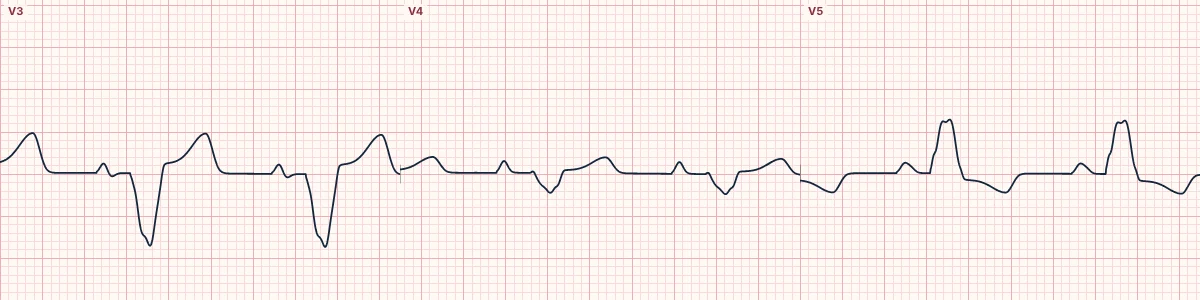
The sign
Look at the S wave in V3 and V4. In uncomplicated LBBB it climbs smoothly back toward the baseline. A distinct notch on that climb, lasting about 40 ms, is Cabrera's sign.
Why it happens
Scar in the septum or anterior wall interrupts the slow, cell-to-cell spread of activation that LBBB produces. The wavefront detours around the dead tissue, and the detour appears as a notch in the leads that face it.
How to use it
It points to an established infarction in a patient whose LBBB otherwise hides one. It is not a test for acute occlusion: use the modified Sgarbossa criteria for that.
About the demonstration
The tracing shows uncomplicated LBBB, which the lab draws without scar. Use it to learn where to look: here the S-wave upstroke in V3 and V4 is smooth, as it should be.
How to read it
- Confirm LBBB first.
- Magnify V3 and V4 and follow the S wave back up to the baseline.
- A notch about one small box wide is significant; a tiny wobble is not.
Pitfalls
- Notching of the R wave in the lateral leads is part of LBBB; Cabrera's sign is on the S wave.
- Its absence does not exclude a prior infarct.
Frequently asked questions
Cabrera sign: what is the key idea?
In left bundle branch block, a notch of about 40 ms on the upstroke of the S wave in V3–V4 suggests a myocardial infarction. It is specific but insensitive.
Cabrera sign: what are the key numbers?
Specificity for infarction: High; Sensitivity: Low: most infarcts in LBBB do not show it; Not for: Diagnosing acute occlusion.
Cabrera sign: how do you apply it to an ECG?
Confirm LBBB first. Magnify V3 and V4 and follow the S wave back up to the baseline. A notch about one small box wide is significant; a tiny wobble is not.
Cabrera sign: what are the common pitfalls?
Notching of the R wave in the lateral leads is part of LBBB; Cabrera's sign is on the S wave. Its absence does not exclude a prior infarct.