
Occlusion MI and ischemia signs
Draft — pending owner review
South African flag sign
A high lateral occlusion read across the page
A way to spot a high lateral infarction: ST elevation in I, aVL and V2 with ST depression in III. On a standard printout these leads trace the shape of the South African flag.
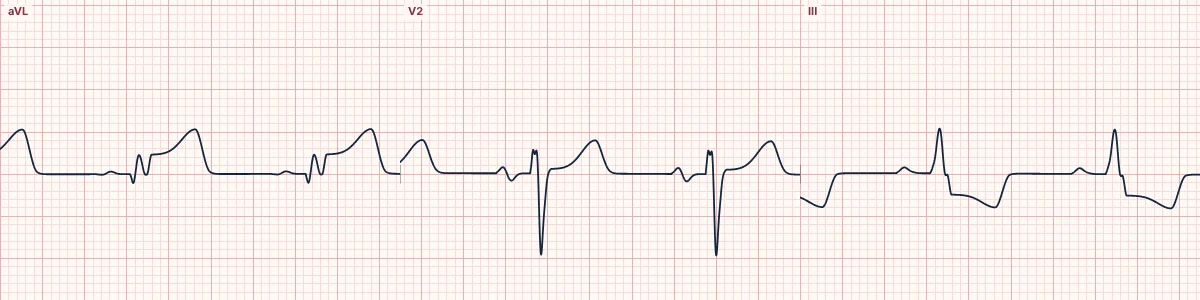
What it shows
Occlusion of the first diagonal branch of the LAD (sometimes an obtuse marginal or ramus branch) injures the high lateral wall. Leads I and aVL face it directly, and V2 also records elevation from this territory. Lead III looks from the opposite side and shows reciprocal ST depression.
Why it is missed
The ST elevation in I and aVL is often small because the QRS in those leads is small, and the elevated leads are not neighbors on the printout. Seen together, with the reciprocal change in III, the pattern stands out.
About the demonstration
The live tracing is the lab's first diagonal occlusion: ST elevation in I, aVL and V2 with depression in III and aVF. Switch to 12 leads to see the pattern across the page.
How to read it
- Whenever III shows ST depression, look for elevation in aVL and I.
- Check V2 for elevation out of keeping with V3–V4.
- Treat the combination as an occlusion MI even if it misses the usual thresholds.
Pitfalls
- ST depression in III alone is often dismissed as nonspecific.
- LVH can depress the ST in III; look for true elevation in I and aVL.
Frequently asked questions
South African flag sign: what is the key idea?
A way to spot a high lateral infarction: ST elevation in I, aVL and V2 with ST depression in III. On a standard printout these leads trace the shape of the South African flag.
South African flag sign: what are the key numbers?
Threshold: Even 1 mm in I and aVL matters when the QRS is small; Clearest part: Often the depression in III.
South African flag sign: how do you apply it to an ECG?
Whenever III shows ST depression, look for elevation in aVL and I. Check V2 for elevation out of keeping with V3–V4. Treat the combination as an occlusion MI even if it misses the usual thresholds.
South African flag sign: what are the common pitfalls?
ST depression in III alone is often dismissed as nonspecific. LVH can depress the ST in III; look for true elevation in I and aVL.