
Rate-related aberrancy
Rate-related RBBB aberrancy (Ashman)
An early beat after a long pause reaches the right bundle while it is still refractory and is conducted with an RBBB shape. Typical in atrial fibrillation.
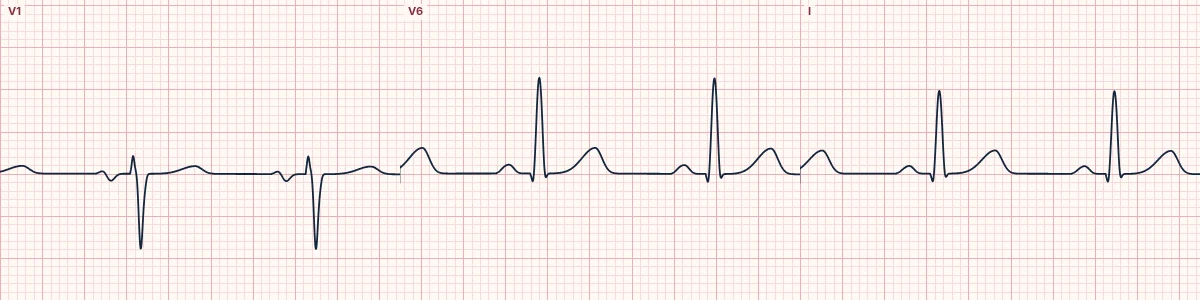
What the heart is doing
The right bundle's refractory period lengthens after a long cycle. An impulse arriving early finds it unrecovered, travels down the left bundle alone and reaches the right ventricle late.
Why it looks this way
This is rate-related RBBB aberrancy because wide rsR′ beats appear only when a short R–R follows a long one.
Why it matters
Harmless in its own right. Its importance is in not mistaking the wide beats for PVCs or short runs of VT and treating them unnecessarily.
What to look for
- Find the wide beat and check the two intervals before it: long, then short.
- The wide beat has a triphasic rsR′ shape in V1 and begins like the normal beats.
- In atrial fibrillation, there is no fixed coupling interval and no pause after it.
Frequently asked questions
What are the ECG criteria for rate-related RBBB aberrancy (Ashman)?
QRS: wide (≥ 120 ms) on the aberrant beats only. V1: rsR′ on the aberrant beat. Timing: A short R–R that follows a long R–R. Initial deflection: same direction as the normal beats. Pause: no compensatory pause afterward.
How is rate-related RBBB aberrancy (Ashman) identified on an ECG?
This is rate-related RBBB aberrancy because wide rsR′ beats appear only when a short R–R follows a long one.
What can rate-related RBBB aberrancy (Ashman) be mistaken for?
PVC: fixed coupling, no rsR′ shape, followed by a compensatory pause. Non-sustained VT: consecutive wide beats with a different initial deflection. Intermittent pre-excitation: slurred delta wave onset.
What causes rate-related RBBB aberrancy (Ashman)?
Common causes: atrial fibrillation with long–short cycles; early premature atrial complexes; onset of supraventricular tachycardia; and sudden rise in heart rate.