
Inherited syndromes
Draft — pending owner review
Familial ST-segment depression (Bundgaard syndrome)
Inherited, lifelong ST depression
A recently described inherited syndrome with persistent, widespread, concave ST depression and ST elevation in aVR, without coronary disease. It is linked to atrial fibrillation, ventricular arrhythmias and sudden death.
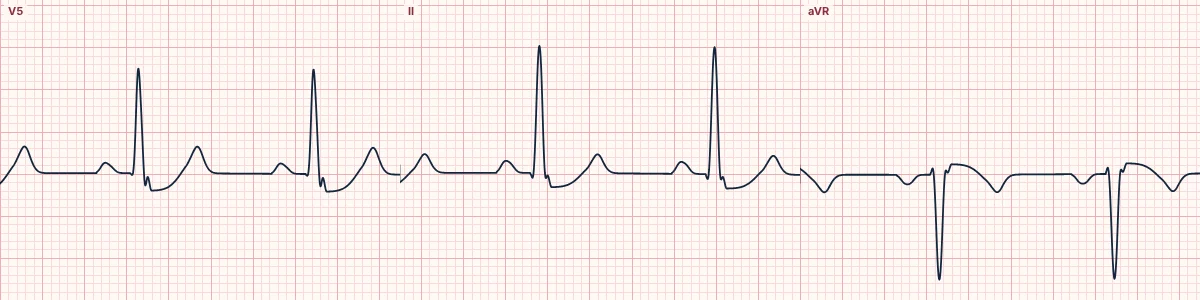
Proposed criteria
Unexplained concave-upward ST depression in at least seven leads, measured 90 ms after the J point; ST elevation in aVR over 1 mm; changes that persist over years; and an autosomal dominant family pattern.
Why it matters
The ECG looks like severe subendocardial ischemia or left main disease. In a patient with chest pain it can lead to repeated invasive tests; old ECGs with the same pattern, normal coronary arteries and an affected relative point to the syndrome.
Arrhythmia risk
Affected people may be well for decades, then develop atrial fibrillation and later VT or VF. The genetic cause is not yet known.
About the demonstration
The tracing uses the lab's subendocardial ischemia model: diffuse ST depression with elevation in aVR. In the syndrome the depression is concave and unchanged over time.
How to read it
- Compare with old ECGs: diffuse ST depression unchanged over years is unusual for ischemia.
- Ask about family history of arrhythmia and sudden death.
- Exclude ischemia, structural disease, drugs and electrolytes first.
Pitfalls
- It is a diagnosis of exclusion; acute ischemia comes first.
- Digoxin and LVH also cause diffuse ST depression.
Frequently asked questions
Familial ST-segment depression (Bundgaard syndrome): what is the key idea?
A recently described inherited syndrome with persistent, widespread, concave ST depression and ST elevation in aVR, without coronary disease. It is linked to atrial fibrillation, ventricular arrhythmias and sudden death.
Familial ST-segment depression (Bundgaard syndrome): what are the key numbers?
ST depression: Concave, at least 7 leads; aVR: ST elevation > 1 mm; Course: Stable for years; Inheritance: Autosomal dominant.
Familial ST-segment depression (Bundgaard syndrome): how do you apply it to an ECG?
Compare with old ECGs: diffuse ST depression unchanged over years is unusual for ischemia. Ask about family history of arrhythmia and sudden death. Exclude ischemia, structural disease, drugs and electrolytes first.
Familial ST-segment depression (Bundgaard syndrome): what are the common pitfalls?
It is a diagnosis of exclusion; acute ischemia comes first. Digoxin and LVH also cause diffuse ST depression.