
Bundle branch block
Incomplete right bundle branch block
Slight delay in the right bundle branch produces the RBBB shape in V1 while the QRS stays under 120 ms. Commonly a normal variant.
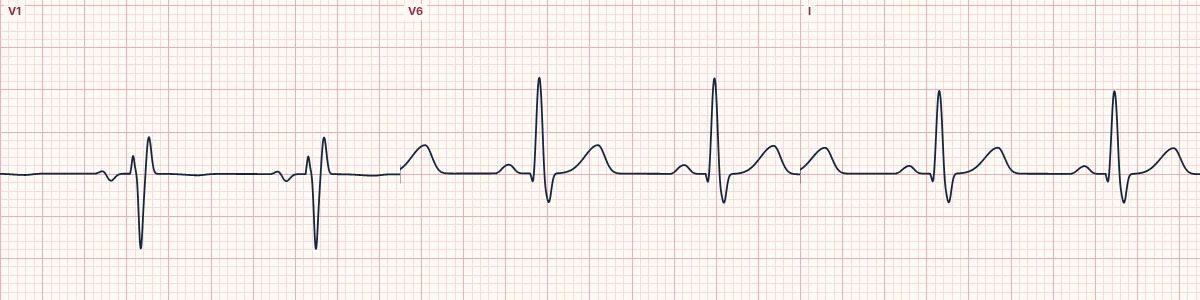
What the heart is doing
Conduction down the right bundle is slowed but not blocked, so the last part of the right ventricle depolarizes slightly late. This adds a small terminal force toward V1.
Why it looks this way
This is incomplete RBBB because V1 shows an rsr′ pattern while the QRS is between 100 and 119 ms.
Why it matters
Usually harmless and needs no action. In a breathless patient or one with a murmur, consider right heart strain or an atrial septal defect.
What to look for
- A small second upward deflection (r′) at the end of the QRS in V1.
- Measure the QRS: under 120 ms, so it does not meet criteria for complete RBBB.
- Check that the ST segment in V1–V2 is not elevated, which would suggest Brugada pattern.
Frequently asked questions
What are the ECG criteria for incomplete right bundle branch block?
QRS: 100–119 ms. V1: rsr′ or rsR′ pattern. V6 and I: small terminal S wave. ST–T: usually normal.
How is incomplete right bundle branch block identified on an ECG?
This is incomplete RBBB because V1 shows an rsr′ pattern while the QRS is between 100 and 119 ms.
What can incomplete right bundle branch block be mistaken for?
Complete RBBB: QRS 120 ms or more with a broad S in V6. Brugada pattern, type 2: saddle-shaped ST elevation in V1–V2. High V1 placement: r′ with an inverted P wave in V1.
What causes incomplete right bundle branch block?
Common causes: normal variant in the young and athletic; atrial septal defect; right ventricular volume or pressure load; V1 electrode placed too high; and early conduction disease.