
Conduction system disease
Draft — pending owner review
Trifascicular block
Bifascicular block with a long PR
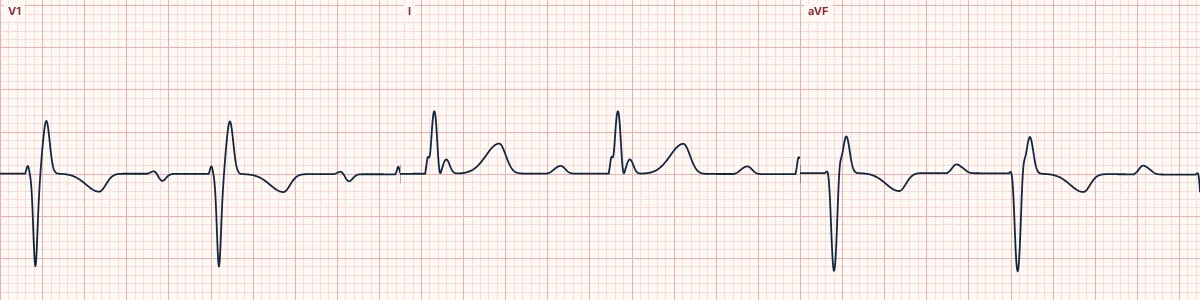
Bifascicular block (RBBB with left anterior or posterior fascicular block) together with first-degree AV block. The term is loose: the long PR may come from the AV node, but the pattern marks advanced conduction disease.
The pattern
RBBB plus LAFB or LPFB shows that two of the three fascicles are blocked; a PR over 200 ms may mean slow conduction in the third. True block of all three fascicles would be complete heart block, so the classic pattern is better called bifascicular block with first-degree AV block.
Why it matters
A patient with syncope and this pattern may be having intermittent complete heart block and needs monitoring and a pacing assessment. Without symptoms, the yearly risk of progression is low.
Alternating bundle branch block
RBBB on one ECG and LBBB on another, or alternating on the same strip, is a stronger sign of disease below the AV node and an indication for pacing.
About the demonstration
The tracing combines first-degree AV block with RBBB and left anterior fascicular block: a long PR, an rsR′ in V1 and left axis deviation.
How to read it
- Confirm RBBB, then use the axis to name the blocked fascicle.
- Measure the PR interval.
- Ask about syncope and look for dropped beats on a long strip.
Pitfalls
- The long PR usually reflects the AV node, so the label can overstate the risk.
- Mobitz II with bifascicular block is a pacing emergency, not a variant of this pattern.
Frequently asked questions
Trifascicular block: what is the key idea?
Bifascicular block (RBBB with left anterior or posterior fascicular block) together with first-degree AV block. The term is loose: the long PR may come from the AV node, but the pattern marks advanced conduction disease.
Trifascicular block: what are the key numbers?
With syncope: Look for intermittent complete heart block; Alternating BBB: Pacing indication; Without symptoms: Low yearly risk of progression.
Trifascicular block: how do you apply it to an ECG?
Confirm RBBB, then use the axis to name the blocked fascicle. Measure the PR interval. Ask about syncope and look for dropped beats on a long strip.
Trifascicular block: what are the common pitfalls?
The long PR usually reflects the AV node, so the label can overstate the risk. Mobitz II with bifascicular block is a pacing emergency, not a variant of this pattern.