
Pre-excitation
WPW pattern, right-sided pathway (type B)
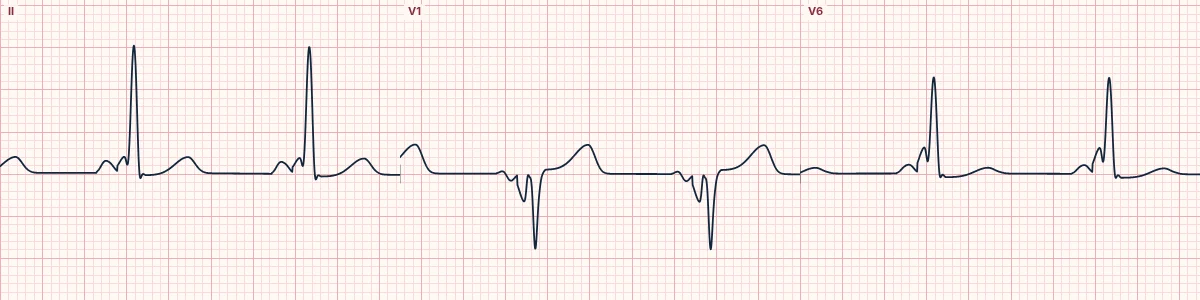
An accessory pathway on the right side of the heart activates the right ventricle early. PR is short, with a delta wave and a mostly negative QRS in V1.
What the heart is doing
A right-sided muscle bridge conducts without AV-nodal delay, so the right ventricle starts depolarizing early. The resulting wavefront moves away from V1 and merges with normal activation.
Why it looks this way
This is the WPW pattern (type B) because the PR is under 120 ms and a delta wave widens the QRS, which is mainly negative in V1.
Why it matters
As for any WPW pattern: harmless until tachyarrhythmias occur, then at risk of AVRT and rapid pre-excited atrial fibrillation. Symptoms warrant specialist assessment and possible ablation.
What to look for
- Short PR with a slurred start to the QRS in the lateral leads (I, aVL, V5–V6).
- V1 is predominantly negative, pointing to a right-sided pathway.
- A negative delta wave in V1–V2 can pass for an anteroseptal Q wave.
Frequently asked questions
What are the ECG criteria for WPW pattern, right-sided pathway (type B)?
PR interval: < 120 ms. QRS: ≥ 110 ms with a slurred upstroke (delta wave). V1: negative delta wave; QS or rS (LBBB-like). ST–T: opposite to the delta wave.
How is WPW pattern, right-sided pathway (type B) identified on an ECG?
This is the WPW pattern (type B) because the PR is under 120 ms and a delta wave widens the QRS, which is mainly negative in V1.
What can WPW pattern, right-sided pathway (type B) be mistaken for?
LBBB: normal PR and no slurred delta wave. Old anteroseptal infarction: true Q waves in V1–V2 with a normal PR. Left ventricular hypertrophy: deep S in V1 with a normal PR.
What causes WPW pattern, right-sided pathway (type B)?
Common causes: congenital accessory AV pathway; ebstein anomaly of the tricuspid valve; usually a structurally normal heart; and familial forms (rare).