
Pre-excitation
Draft — pending owner review
Short PR without pre-excitation (LGL pattern)
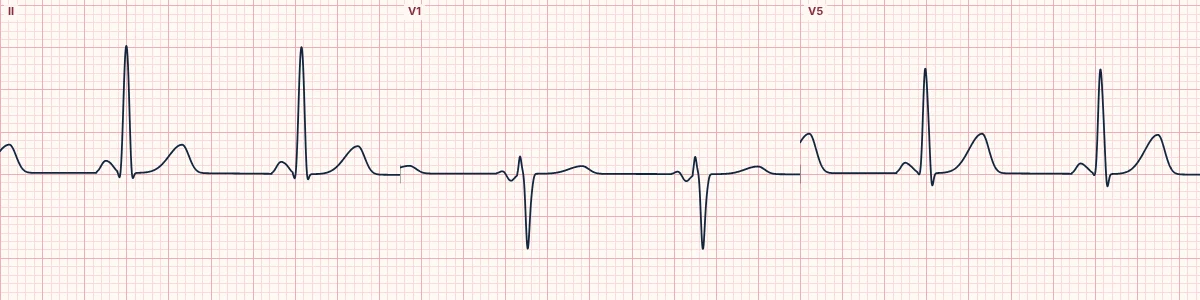
A PR interval under 120 ms with a normal, narrow QRS and no delta wave. Once called Lown–Ganong–Levine syndrome, it is now regarded as a pattern rather than a disease.
What the heart is doing
The impulse crosses the AV node faster than usual, or skirts part of it, so the pause between atrial and ventricular activation is short. The ventricles are then activated through the normal His–Purkinje system.
Why it looks this way
This is a short PR without pre-excitation because the PR is under 120 ms while the QRS is narrow, normal and has no delta wave.
Why it matters
Usually harmless. What matters is what it is not: without a delta wave it is not WPW. Palpitations in these patients are often AVNRT, and fast AV conduction can let atrial fibrillation or flutter reach the ventricles quickly.
What to look for
- Measure the PR: under three small boxes.
- Check the QRS upstroke: no slur (delta wave) and a normal width.
- Confirm the P wave is upright in II, so this is not a junctional rhythm.
Frequently asked questions
What are the ECG criteria for short PR without pre-excitation (LGL pattern)?
PR interval: < 120 ms. QRS: normal width, no delta wave. P waves: normal sinus P waves, upright in II. Syndrome: only with documented episodes of SVT.
How is short PR without pre-excitation (LGL pattern) identified on an ECG?
This is a short PR without pre-excitation because the PR is under 120 ms while the QRS is narrow, normal and has no delta wave.
What can short PR without pre-excitation (LGL pattern) be mistaken for?
WPW type A: short PR with a delta wave and a wider QRS. Accelerated junctional rhythm: P waves inverted in II, or absent. Ectopic atrial rhythm: P waves inverted in II.
What causes short PR without pre-excitation (LGL pattern)?
Common causes: enhanced AV nodal conduction; normal variant; high sympathetic tone, fever or exercise; and A pathway around part of the AV node (proposed, unproven).