
Junctional & SVT
Accelerated junctional rhythm
The AV junction fires faster than its usual escape rate, at 60–100/min, and takes control from the sinus node. The QRS is narrow.
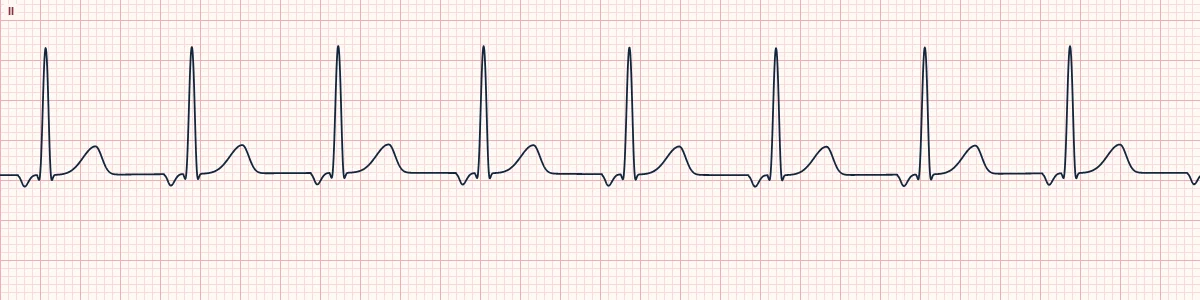
What the heart is doing
Enhanced automaticity makes junctional cells fire faster than the sinus node. Impulses travel down to the ventricles normally and backward into the atria, inverting the P wave.
Why it looks this way
This is an accelerated junctional rhythm because it is regular at 60–100/min with narrow QRS complexes and inverted P waves with a PR under 120 ms.
Why it matters
Usually well tolerated and transient; treat the cause instead of the rhythm. In a patient taking digoxin, assume toxicity until proven otherwise.
What to look for
- A normal-rate, regular narrow rhythm whose P waves are upside down in II, III and aVF.
- Measure the PR: under 120 ms points to the junction rather than a low atrial focus.
- Onset and offset are gradual, as with other automatic rhythms.
Frequently asked questions
What are the ECG criteria for accelerated junctional rhythm?
Rate: 60–100/min. Rhythm: regular. P waves: inverted in II, here just before the QRS; may be absent or after it. PR interval: < 120 ms when a P wave precedes the QRS. QRS: narrow (< 120 ms).
How is accelerated junctional rhythm identified on an ECG?
This is an accelerated junctional rhythm because it is regular at 60–100/min with narrow QRS complexes and inverted P waves with a PR under 120 ms.
What can accelerated junctional rhythm be mistaken for?
Normal sinus rhythm: P waves upright in II with a PR of at least 120 ms. Ectopic atrial rhythm: inverted P waves but PR ≥ 120 ms. Accelerated idioventricular rhythm: wide QRS.
What causes accelerated junctional rhythm?
Common causes: digoxin toxicity; inferior myocardial infarction; after cardiac surgery; myocarditis; reperfusion after infarction; and beta-agonist or catecholamine excess.