
Junctional & SVT
Junctional escape rhythm
When the sinus node fails or its impulses are blocked, the AV junction takes over as a backup pacemaker at 40–60/min with a narrow QRS.
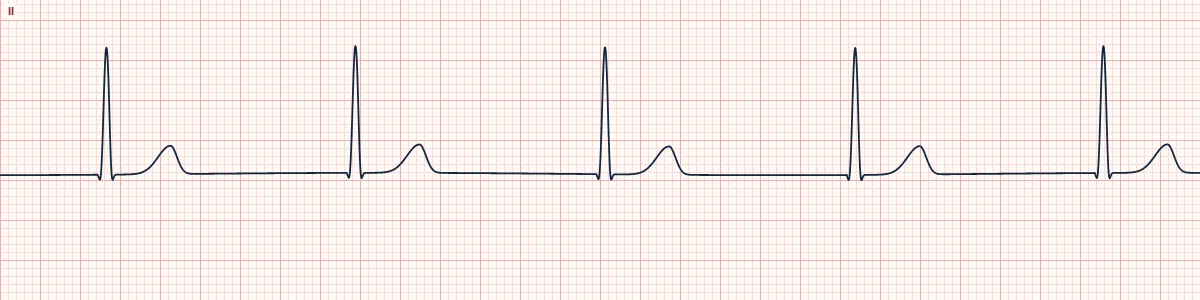
What the heart is doing
With no impulse arriving from above, pacemaker cells in the AV junction fire at their own rate of 40–60/min. Ventricles activate normally; the atria are silent or activated backward.
Why it looks this way
This is a junctional escape rhythm because it is regular at 40–60/min with narrow QRS complexes and no upright P wave before them.
Why it matters
A protective backup that must not be suppressed. Treat the reason the faster pacemaker failed; if the patient is poorly perfused, manage as symptomatic bradycardia with atropine or pacing.
What to look for
- A slow, very regular narrow rhythm with no upright P wave before the QRS.
- Look in the ST segment and just before the QRS for small inverted P waves.
- Ask why the sinus node is not in charge: sinus failure or AV block.
Frequently asked questions
What are the ECG criteria for junctional escape rhythm?
Rate: 40–60/min. Rhythm: regular. P waves: absent, or inverted in II just before or after the QRS. PR interval: none, or < 120 ms. QRS: narrow (< 120 ms).
How is junctional escape rhythm identified on an ECG?
This is a junctional escape rhythm because it is regular at 40–60/min with narrow QRS complexes and no upright P wave before them.
What can junctional escape rhythm be mistaken for?
Sinus bradycardia: upright P wave with a normal PR before each QRS. Atrial fibrillation with slow response: irregular R–R and fibrillatory baseline. Idioventricular rhythm: wide QRS, usually slower than 40/min.
What causes junctional escape rhythm?
Common causes: sinus node dysfunction; high vagal tone; inferior myocardial infarction; beta-blockers, calcium-channel blockers, digoxin; hyperkalemia; and AV block.