
Junctional & SVT
AV nodal re-entrant tachycardia (AVNRT)
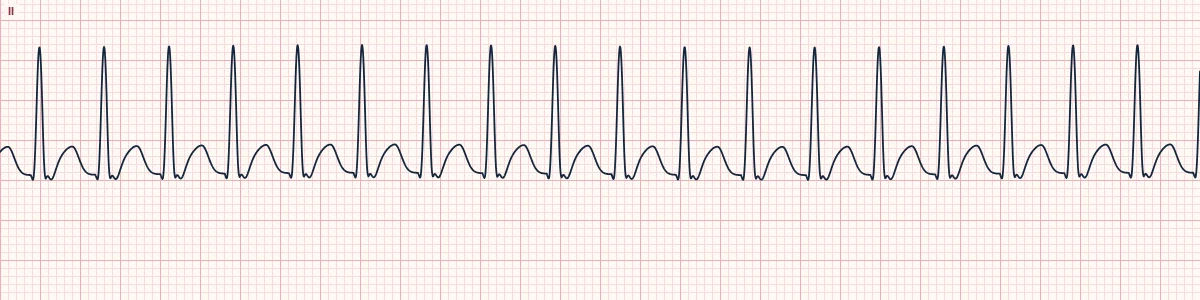
The most common regular SVT: an impulse circles within the AV node, firing the atria and ventricles almost simultaneously at 140–250/min.
What the heart is doing
The AV node has a slow and a fast pathway. An early beat travels down the slow one and returns up the fast one, forming a tight loop that fires the atria and ventricles nearly together.
Why it looks this way
This is AVNRT because the narrow tachycardia is perfectly regular with the retrograde P wave buried at the very end of the QRS (RP under 90 ms).
Why it matters
Usually tolerated but uncomfortable. Stable patients are treated with vagal maneuvers, then adenosine; unstable patients need immediate synchronized cardioversion. Recurrent episodes can be cured by ablation.
What to look for
- Look at the end of the QRS: a pseudo-S wave in II, III, aVF or a pseudo-r′ in V1 is the retrograde P.
- No atrial activity is visible between the QRS complexes.
- The rate is fixed and does not drift with activity or breathing.
Frequently asked questions
What are the ECG criteria for AV nodal re-entrant tachycardia (AVNRT)?
Rate: 140–250/min, often about 180. Rhythm: perfectly regular; abrupt onset and offset. P waves: hidden in the QRS or seen at its very end. RP interval: very short (< 90 ms). QRS: narrow (< 120 ms).
How is AV nodal re-entrant tachycardia (AVNRT) identified on an ECG?
This is AVNRT because the narrow tachycardia is perfectly regular with the retrograde P wave buried at the very end of the QRS (RP under 90 ms).
What can AV nodal re-entrant tachycardia (AVNRT) be mistaken for?
Orthodromic AVRT: retrograde P wave clearly separate, in the ST segment. Atrial flutter 2:1: rate about 150/min with sawtooth waves. Sinus tachycardia: upright P before each QRS and a gradually changing rate.
What causes AV nodal re-entrant tachycardia (AVNRT)?
Common causes: dual AV nodal pathways present from birth; triggered by a PAC or PVC; caffeine, alcohol, stimulants; stress or exertion; and often young, otherwise healthy adults.