
Atrial
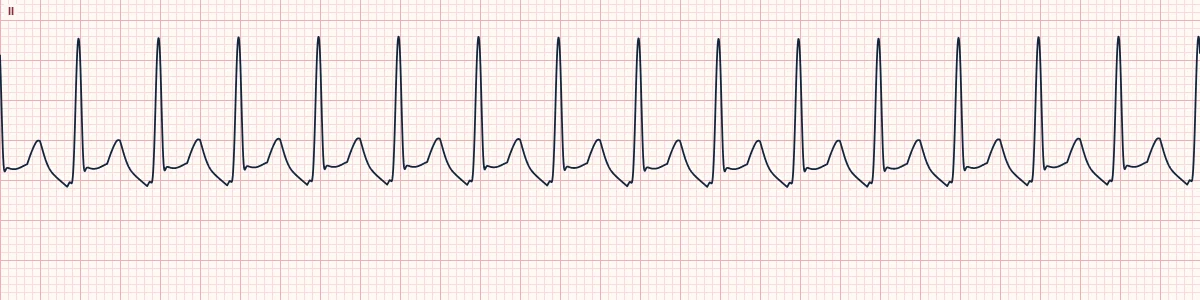
Atrial flutter, 2:1 conduction
Atrial flutter in which every second flutter wave conducts, giving a regular narrow tachycardia at about 150/min. Half the flutter waves hide in the QRS and T wave.
What the heart is doing
A right atrial re-entrant circuit runs at about 300/min. The AV node is refractory after each conducted impulse and blocks the next, so the ventricles follow at exactly half the atrial rate.
Why it looks this way
This is atrial flutter with 2:1 conduction because the regular narrow rhythm sits at about 150/min with two sawtooth waves for every QRS.
Why it matters
Unstable patients need immediate synchronized cardioversion. Stable patients get rate control and stroke-risk assessment. The rate barely changes with activity, a useful clue against sinus tachycardia.
What to look for
- Treat any regular narrow tachycardia fixed at about 150/min as flutter until proven otherwise.
- Look halfway between two visible atrial waves: a second wave sits in the T wave or QRS.
- Turning the strip upside down or slowing the AV node briefly makes the sawtooth obvious.
Frequently asked questions
What are the ECG criteria for atrial flutter, 2:1 conduction?
Atrial rate: 250–350/min (typically 300). Ventricular rate: about 150/min, regular. Flutter waves: sawtooth in II, III, aVF; one is buried in the T wave. Conduction: 2 flutter waves for each QRS. QRS: narrow (< 120 ms).
How is atrial flutter, 2:1 conduction identified on an ECG?
This is atrial flutter with 2:1 conduction because the regular narrow rhythm sits at about 150/min with two sawtooth waves for every QRS.
What can atrial flutter, 2:1 conduction be mistaken for?
Sinus tachycardia: rate varies over time and there is one upright P per QRS. AVNRT: no atrial waves visible between the QRS complexes. Focal atrial tachycardia: flat baseline between P waves.
What causes atrial flutter, 2:1 conduction?
Common causes: heart failure and atrial enlargement; COPD, pulmonary embolism; valvular and ischemic heart disease; after cardiac surgery; hyperthyroidism; and alcohol.