
Atrial
Atrial flutter, variable conduction
Atrial flutter in which the AV node conducts a changing number of flutter waves (2:1, 3:1, 4:1), so the ventricular rhythm is irregular.
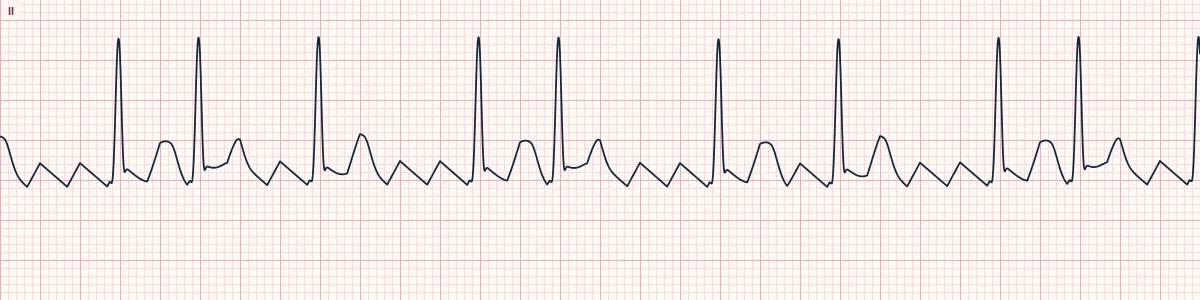
What the heart is doing
The atrial circuit is perfectly regular at about 300/min, but the AV node's recovery varies from beat to beat, so the number of flutter waves blocked before each conducted one keeps changing.
Why it looks this way
This is atrial flutter with variable conduction because uniform sawtooth waves at about 300/min are followed by QRS complexes at changing ratios.
Why it matters
Managed like other flutter: rate or rhythm control and stroke-risk assessment, with synchronized cardioversion if unstable. The irregular pulse is easily mistaken for atrial fibrillation.
What to look for
- The sawtooth waves are regular and identical even though the QRS complexes are not.
- Each R–R interval is a whole-number multiple of the flutter cycle (about 200 ms).
- Longer R–R intervals expose several flutter waves in a row and make the diagnosis easy.
Frequently asked questions
What are the ECG criteria for atrial flutter, variable conduction?
Atrial rate: 250–350/min (typically 300). Ventricular rate: variable, usually 75–150/min. Rhythm: irregular, often in repeating groups. Flutter waves: identical sawtooth waves in II, III, aVF. QRS: narrow (< 120 ms).
How is atrial flutter, variable conduction identified on an ECG?
This is atrial flutter with variable conduction because uniform sawtooth waves at about 300/min are followed by QRS complexes at changing ratios.
What can atrial flutter, variable conduction be mistaken for?
Atrial fibrillation: atrial activity is chaotic, with no repeating wave shape. Multifocal atrial tachycardia: discrete P waves of several shapes and a flat baseline. Atrial tachycardia with variable block: flat baseline between P waves.
What causes atrial flutter, variable conduction?
Common causes: heart failure and atrial enlargement; COPD and pulmonary hypertension; valvular and ischemic heart disease; after cardiac surgery; and AV nodal blocking drugs changing the ratio.