
Junctional & SVT
Junctional tachycardia
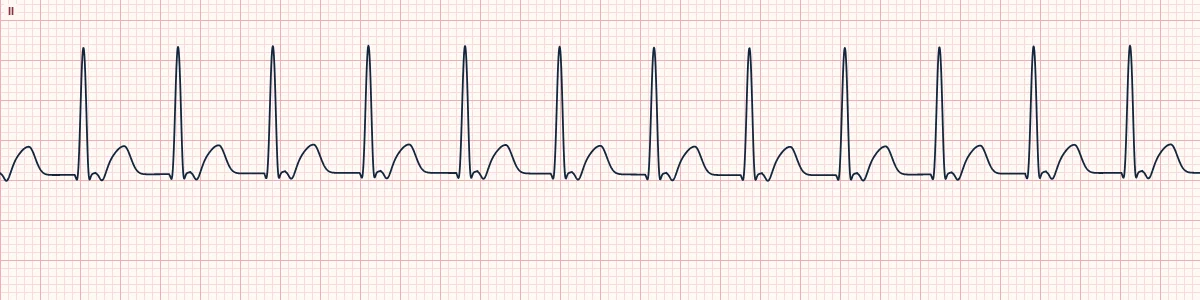
An automatic focus in the AV junction fires faster than 100/min, giving a regular narrow tachycardia with inverted P waves near the QRS or none at all.
What the heart is doing
Junctional cells with abnormally high automaticity fire above 100/min. Each impulse descends normally to the ventricles and climbs backward into the atria, so the P wave is inverted and late.
Why it looks this way
This is junctional tachycardia because the regular narrow rhythm is above 100/min with inverted retrograde P waves and no upright P before the QRS.
Why it matters
Uncommon in adults and usually a sign of something else, especially digoxin toxicity. Treat the cause; unstable patients are managed as for other narrow tachycardias, though cardioversion may fail.
What to look for
- A regular narrow tachycardia with no upright P wave before the QRS.
- Look in the ST segment for a small negative deflection in II: the retrograde P wave.
- It speeds up and slows down gradually, unlike re-entrant SVT.
Frequently asked questions
What are the ECG criteria for junctional tachycardia?
Rate: > 100/min, usually 100–180/min. Rhythm: regular. P waves: inverted in II, here just after the QRS; may be absent or before it. PR interval: none, or < 120 ms. QRS: narrow (< 120 ms).
How is junctional tachycardia identified on an ECG?
This is junctional tachycardia because the regular narrow rhythm is above 100/min with inverted retrograde P waves and no upright P before the QRS.
What can junctional tachycardia be mistaken for?
AVNRT: abrupt onset and offset, usually faster, P wave fused with the QRS. Orthodromic AVRT: abrupt onset, retrograde P wave further out in the ST segment. Sinus tachycardia with a long PR: the upright P wave is hiding in the T wave.
What causes junctional tachycardia?
Common causes: digoxin toxicity; after cardiac surgery, especially in children; myocardial ischemia or infarction; myocarditis; and catecholamine excess.