
Junctional & SVT
Pre-excited atrial fibrillation (AF with WPW)
Atrial fibrillation conducted down an accessory pathway that bypasses the AV node. The result is a very fast, irregular, wide-complex rhythm that can turn into VF.
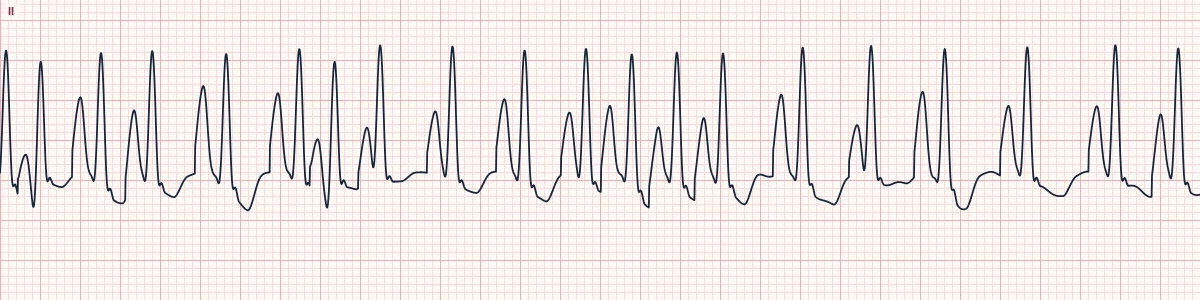
What the heart is doing
Fibrillating atria send impulses down both the AV node and the accessory pathway. The pathway has no built-in delay, so it conducts very rapidly and each beat is a different fusion of the two routes.
Why it looks this way
This is pre-excited atrial fibrillation because the rhythm is very fast and irregular with wide QRS complexes that keep changing shape.
Why it matters
Life-threatening. Drugs that block only the AV node (adenosine, beta-blockers, calcium-channel blockers, digoxin) can speed pathway conduction and provoke VF. Unstable patients need immediate cardioversion.
What to look for
- Fast, broad and irregular: think of pre-excited AF before anything else.
- The QRS varies from narrow to very wide as the degree of pre-excitation changes.
- The axis stays stable, unlike the twisting of polymorphic VT.
Frequently asked questions
What are the ECG criteria for pre-excited atrial fibrillation (AF with WPW)?
Rate: often 180–300/min. Rhythm: irregularly irregular. P waves: none. QRS: wide, with shape and width changing beat to beat. Shortest R–R: may be under 250 ms.
How is pre-excited atrial fibrillation (AF with WPW) identified on an ECG?
This is pre-excited atrial fibrillation because the rhythm is very fast and irregular with wide QRS complexes that keep changing shape.
What can pre-excited atrial fibrillation (AF with WPW) be mistaken for?
Polymorphic VT: the axis twists around the baseline. AF with bundle branch block: constant QRS shape and a slower rate. Monomorphic VT: regular rhythm with uniform complexes.
What causes pre-excited atrial fibrillation (AF with WPW)?
Common causes: WPW with a pathway that conducts rapidly; onset of AF in a patient with pre-excitation; AVRT degenerating into AF; and alcohol or stimulants.