
Ventricular
Monomorphic ventricular tachycardia
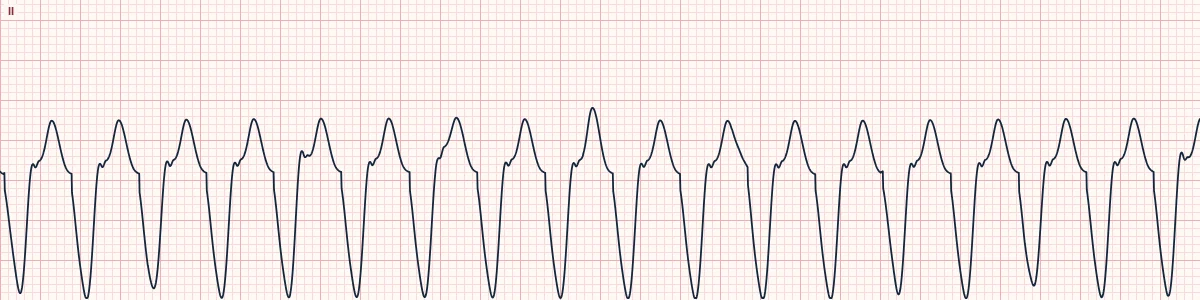
A fast rhythm arising in the ventricles with every beat the same shape. It can be tolerated briefly, but often causes collapse and can degenerate into VF.
What the heart is doing
A re-entry circuit around ventricular scar, or a rapid focus, drives the ventricles from within the muscle. Activation bypasses the Purkinje network, and the atria beat on independently.
Why it looks this way
This is monomorphic VT because the tachycardia is regular with wide, uniform QRS complexes and atrial activity dissociated from the ventricles.
Why it matters
Check for a pulse. Pulseless VT is treated as cardiac arrest with CPR and defibrillation; unstable VT with a pulse needs immediate synchronized cardioversion; stable VT gets antiarrhythmics and expert help.
What to look for
- A regular, wide, fast rhythm: assume VT until proven otherwise.
- Look for P waves marching through at a slower rate, deforming occasional ST–T segments.
- Capture and fusion beats, or all chest leads pointing the same way, confirm VT.
Frequently asked questions
What are the ECG criteria for monomorphic ventricular tachycardia?
Rate: > 100/min, usually 120–250/min. Rhythm: regular. P waves: dissociated; often hidden. QRS: wide (≥ 120 ms, often > 160 ms), uniform. Axis: often extreme (negative in I and aVF).
How is monomorphic ventricular tachycardia identified on an ECG?
This is monomorphic VT because the tachycardia is regular with wide, uniform QRS complexes and atrial activity dissociated from the ventricles.
What can monomorphic ventricular tachycardia be mistaken for?
SVT with bundle branch block: typical RBBB or LBBB shape and a P wave tied to each QRS. Antidromic AVRT: slurred delta-like onset in a patient with WPW. Hyperkalemia or sodium-channel blocker toxicity: very wide QRS at a slower rate.
What causes monomorphic ventricular tachycardia?
Common causes: scar from prior myocardial infarction; acute ischemia; cardiomyopathy and heart failure; hypokalemia, hypomagnesemia; drug toxicity; and inherited arrhythmia syndromes.