
Ventricular
Ventricular trigeminy
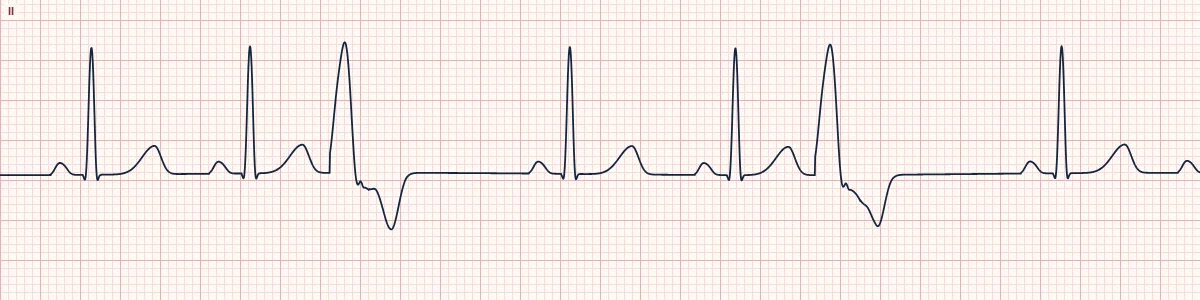
A repeating three-beat pattern in which every third beat is a PVC: two normal beats, then a PVC and a pause.
What the heart is doing
A ventricular focus discharges after every second sinus beat. Each PVC blocks the sinus impulse that follows, producing a compensatory pause before the cycle starts again.
Why it looks this way
This is ventricular trigeminy because every third beat is a wide, premature PVC in a repeating three-beat cycle.
Why it matters
Approach as for other frequent PVCs: find and correct the cause. In an otherwise well person with a normal heart it is usually benign.
What to look for
- Count the beats in each group: two narrow sinus beats then one wide early beat.
- The pattern repeats along the whole strip with the same PVC shape.
- A pause follows every PVC before the next pair of sinus beats.
Frequently asked questions
What are the ECG criteria for ventricular trigeminy?
Rate: depends on the sinus rate. Rhythm: regularly irregular, in groups of three. P waves: before the sinus beats only. QRS: two narrow beats, then one wide PVC. Pause: fully compensatory after each PVC.
How is ventricular trigeminy identified on an ECG?
This is ventricular trigeminy because every third beat is a wide, premature PVC in a repeating three-beat cycle.
What can ventricular trigeminy be mistaken for?
Atrial trigeminy: the early beat is narrow with a P wave. Ventricular bigeminy: every second beat is a PVC. 4:3 Wenckebach: grouped narrow beats with a lengthening PR.
What causes ventricular trigeminy?
Common causes: myocardial ischemia; hypokalemia, hypomagnesemia; cardiomyopathy and heart failure; stimulants and caffeine; hypoxia; and idiopathic.