
Junctional & SVT
Premature junctional complexes
Early beats that arise in the AV junction. The QRS is narrow and early; the P wave is missing, or inverted just before or after the QRS.
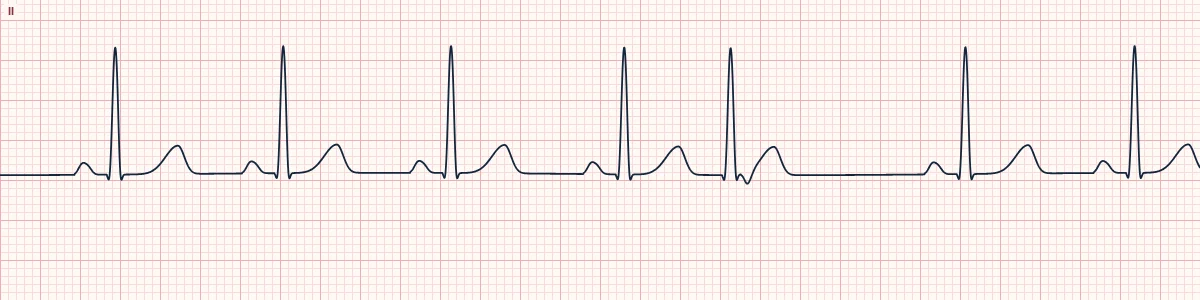
What the heart is doing
A focus in the AV junction fires early. The impulse travels down the His–Purkinje system normally and, at the same time, backward into the atria, producing an inverted P wave near the QRS.
Why it looks this way
These are PJCs because the early QRS is narrow and has no normal P wave before it, only an inverted retrograde P wave near the QRS.
Why it matters
Usually benign and needs no treatment. Frequent PJCs in a patient on digoxin should raise suspicion of toxicity.
What to look for
- An early narrow QRS with no normal P wave in front of it.
- Check the ST segment right after the early QRS for a small inverted retrograde P wave.
- The early beat looks like its neighbors, which separates it from a PVC.
Frequently asked questions
What are the ECG criteria for premature junctional complexes?
Rate: that of the underlying rhythm. Rhythm: irregular because of early beats. P waves: absent, or inverted in II just before or after the early QRS. PR interval: < 120 ms if a P wave precedes the beat. QRS: narrow, like the sinus beats.
How is premature junctional complexes identified on an ECG?
These are PJCs because the early QRS is narrow and has no normal P wave before it, only an inverted retrograde P wave near the QRS.
What can premature junctional complexes be mistaken for?
PAC: an upright or abnormal early P wave with PR ≥ 120 ms. PVC: wide, bizarre QRS with a discordant T wave. Sinus arrhythmia: every beat has the same normal P wave.
What causes premature junctional complexes?
Common causes: digoxin toxicity; caffeine, nicotine, stimulants; myocardial ischemia; heart failure; electrolyte disturbance; and normal variant.