
Sinus
Normal sinus rhythm
The heart's normal rhythm: every beat starts in the sinus node and travels the usual pathway to the ventricles at 60–100/min.
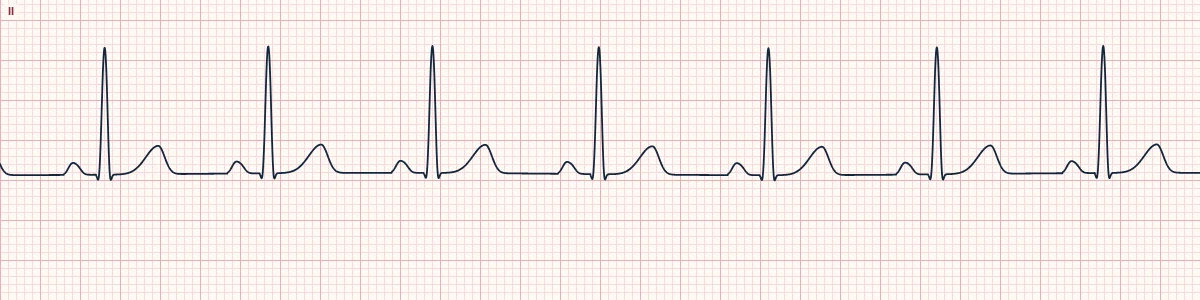
What the heart is doing
The sinus node fires 60–100 times a minute. The impulse crosses both atria, is briefly delayed in the AV node, then spreads rapidly through the His–Purkinje system to both ventricles.
Why it looks this way
This is normal sinus rhythm because the rate is 60–100/min and regular, with an upright P wave and a constant normal PR before every narrow QRS.
Why it matters
The reference rhythm that every other strip is compared with. A normal rhythm does not exclude ischemia, shock or a sick patient, so assess the person and not just the monitor.
What to look for
- Check that every QRS has a P wave in front of it and every P wave is followed by a QRS.
- P waves should be upright in II and inverted in aVR; if not, the impulse is not coming from the sinus node.
- March out the R–R intervals with calipers or paper: they should be essentially equal.
Frequently asked questions
What are the ECG criteria for normal sinus rhythm?
Rate: 60–100/min. Rhythm: regular. P waves: upright in II, one before every QRS. PR interval: 120–200 ms, constant. QRS: narrow (< 120 ms).
How is normal sinus rhythm identified on an ECG?
This is normal sinus rhythm because the rate is 60–100/min and regular, with an upright P wave and a constant normal PR before every narrow QRS.
What can normal sinus rhythm be mistaken for?
Ectopic atrial rhythm: P waves are inverted in II. Atrial flutter 4:1: sawtooth baseline instead of a flat line between beats. Accelerated junctional rhythm: P waves absent, or inverted with a PR < 120 ms.
What causes normal sinus rhythm?
Common causes: normal resting state; healthy sinus node and conduction system; and rhythm restored after a treated arrhythmia.