
Sinus
Sinus pause / arrest
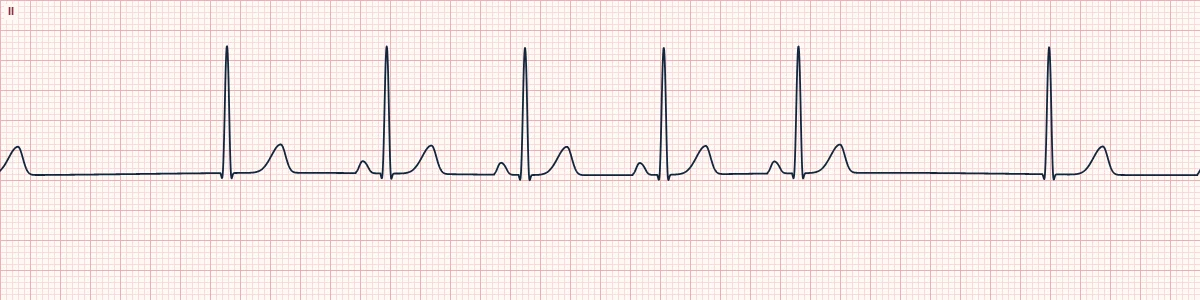
The sinus node fails to fire for a moment, leaving a gap with no P wave, QRS or T wave. A long gap may be ended by a junctional escape beat.
What the heart is doing
The sinus node transiently stops generating impulses, so nothing depolarizes the atria or ventricles. If it stays silent long enough, a lower pacemaker in the AV junction fires an escape beat.
Why it looks this way
This is a sinus pause because an entire P–QRS–T is missing and the gap is not an exact multiple of the underlying P–P interval.
Why it matters
Short pauses can be benign, especially in sleep. Pauses over 3 seconds or with dizziness or syncope point to sinus node disease; review rate-slowing drugs and consider pacing for symptomatic patients.
What to look for
- A flat line where a whole P–QRS–T is missing, not just a QRS.
- Measure the pause: it does not equal two or three normal P–P intervals.
- The beat ending a long pause may be a junctional escape with no P wave in front of it.
Frequently asked questions
What are the ECG criteria for sinus pause / arrest?
Rate: normal or slow, interrupted by pauses. Rhythm: irregular because of sudden pauses. P waves: normal sinus P waves; none during the pause. Pause: not a multiple of the basic P–P interval. QRS: narrow; an escape beat may have no P wave.
How is sinus pause / arrest identified on an ECG?
This is a sinus pause because an entire P–QRS–T is missing and the gap is not an exact multiple of the underlying P–P interval.
What can sinus pause / arrest be mistaken for?
Sinoatrial exit block: the pause is an exact multiple of the P–P interval. Non-conducted PAC: an early P wave is hiding in the T wave before the pause. Mobitz II AV block: P waves keep arriving on time during the pause.
What causes sinus pause / arrest?
Common causes: sinus node dysfunction (sick sinus syndrome); high vagal tone, carotid sinus hypersensitivity; beta-blockers, calcium-channel blockers, digoxin; inferior myocardial infarction; sleep apnea; and hyperkalemia.