
Paced
AV sequential (dual-chamber) pacing
A dual-chamber pacemaker paces the atrium, waits a set AV delay, then paces the ventricle, preserving the normal atrial-then-ventricular sequence.
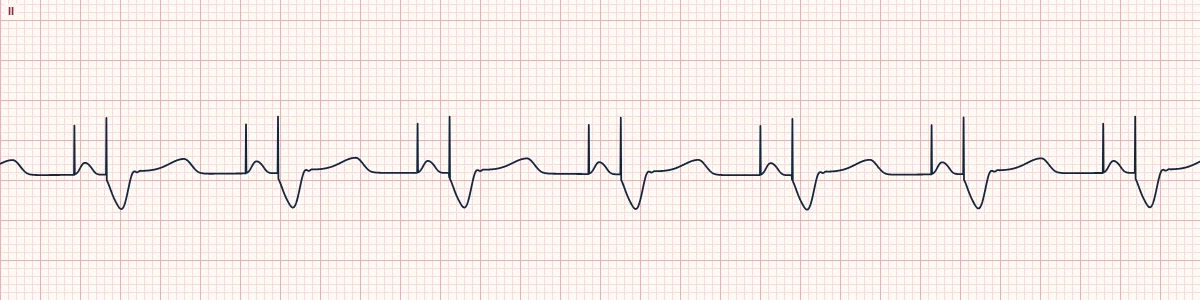
What the heart is doing
The device stimulates the right atrium, times an AV delay that stands in for the AV node, then stimulates the right ventricle. Ventricular activation spreads through muscle, widening the QRS.
Why it looks this way
This is AV sequential pacing because each beat has two spikes: one before the P wave and, after a fixed delay, one before a wide QRS.
Why it matters
Normal dual-chamber function. Keeping the atrial contribution to filling improves cardiac output compared with ventricular pacing alone. Assess capture of both chambers.
What to look for
- Two spikes in each cycle, a constant distance apart.
- A P wave after the first spike and a wide QRS after the second.
- Check that both spikes capture on every beat.
Frequently asked questions
What are the ECG criteria for AV sequential (dual-chamber) pacing?
Rate: the programmed rate, perfectly regular. Pacing spikes: two per beat: atrial, then ventricular. P waves: follow the first spike. AV delay: fixed, usually 120–200 ms between spikes. QRS: wide, LBBB-like, after the second spike.
How is AV sequential (dual-chamber) pacing identified on an ECG?
This is AV sequential pacing because each beat has two spikes: one before the P wave and, after a fixed delay, one before a wide QRS.
What can AV sequential (dual-chamber) pacing be mistaken for?
Ventricular pacing alone: one spike per beat and no paced P wave. Atrial pacing: one spike per beat followed by a narrow QRS. Sinus rhythm with LBBB and artifact: no consistent spikes.
What causes AV sequential (dual-chamber) pacing?
Common causes: AV block with sinus node dysfunction; complete heart block in a patient in sinus rhythm; and symptomatic bradycardia needing AV synchrony.