
Paced
Pacemaker failure to sense
The pacemaker does not detect the heart's own beats and fires regardless. Spikes land at inappropriate times, including inside or just after native beats.
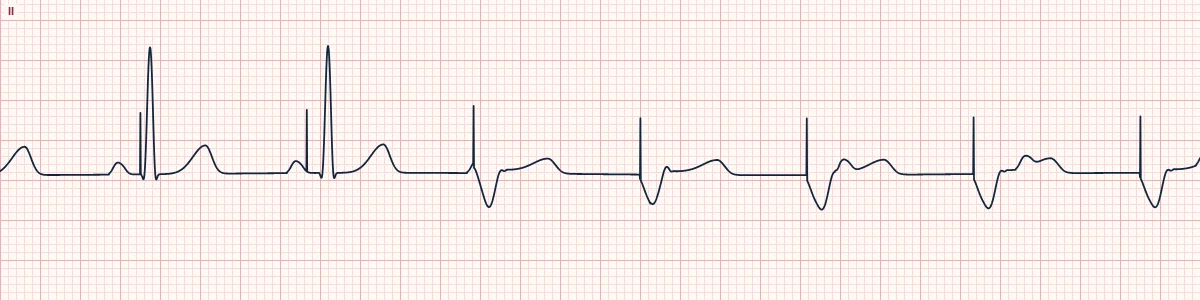
What the heart is doing
The device should withhold a stimulus when it senses a native beat. Because sensing fails, it paces at its fixed rate, and stimuli capture only when they fall outside the refractory period.
Why it looks this way
This is failure to sense because pacing spikes march through at a fixed rate regardless of the patient's own QRS complexes.
Why it matters
Competition between the device and the heart wastes battery and, rarely, a spike on the T wave can trigger a ventricular arrhythmia. Monitor the patient and arrange prompt device interrogation.
What to look for
- March out the spikes: they keep a fixed interval and ignore the patient's own QRS complexes.
- Spikes soon after a native QRS fail to capture because the muscle is still refractory.
- Spikes late enough after a beat do capture and produce a wide QRS.
Frequently asked questions
What are the ECG criteria for pacemaker failure to sense?
Rate: native rhythm plus competing paced beats. Rhythm: irregular. Pacing spikes: at a fixed rate, unrelated to native QRS complexes. QRS: narrow native beats mixed with wide paced beats. Spike timing: some fall in the ST segment or on the T wave.
How is pacemaker failure to sense identified on an ECG?
This is failure to sense because pacing spikes march through at a fixed rate regardless of the patient's own QRS complexes.
What can pacemaker failure to sense be mistaken for?
Normal fusion beats: a spike coinciding with the start of a native QRS. Failure to capture: spikes are timed correctly but produce no QRS. Artifact: spike-like deflections with no fixed interval.
What causes pacemaker failure to sense?
Common causes: lead dislodgement or fracture; low-amplitude native signal (new infarction or bundle branch block); sensitivity programmed incorrectly; battery depletion; and magnet applied (intended fixed-rate mode).