
Other conditions
Draft — pending owner review
Atrial septal defect (crochetage sign)
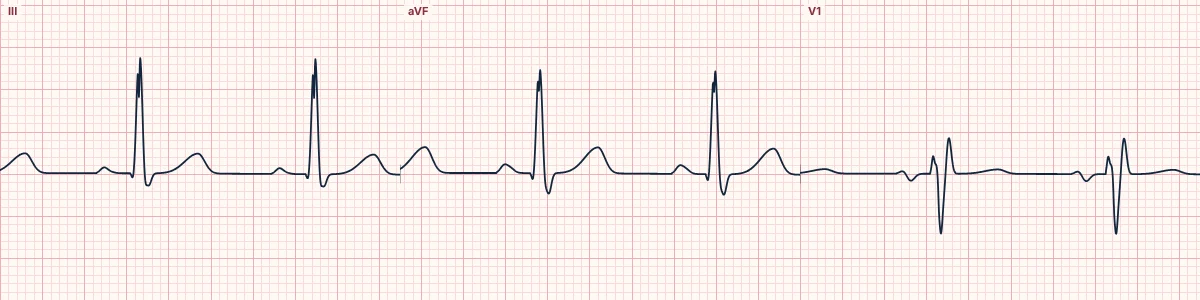
A notch near the peak of the R wave in the inferior leads, linked to secundum atrial septal defect. With an incomplete RBBB pattern and a rightward axis it strongly suggests the defect.
What the heart is doing
The notch is not fully explained; it is thought to reflect altered activation around the enlarged right heart and septum. Right ventricular volume overload delays right-sided activation, giving the r′ in V1.
Why it looks this way
This is the crochetage sign because the R waves in the inferior leads carry a notch near their peak, with an rSr′ in V1 and a rightward axis.
Why it matters
Atrial septal defects often go unnoticed into adult life and present with breathlessness, atrial arrhythmias or paradoxical embolism. A crochetage notch is a cheap clue that should prompt an echocardiogram.
What to look for
- Zoom in on the tip of the R wave in II, III and aVF: a small notch, like a crochet hook.
- Check V1 for the rSr′ of right ventricular volume load.
- Listen for a fixed split second heart sound and arrange an echocardiogram.
Frequently asked questions
What are the ECG criteria for atrial septal defect (crochetage sign)?
Notch: near the apex of the R wave in II, III or aVF. Specificity: highest when present in all three inferior leads or with incomplete RBBB. V1: rSr′ from right ventricular volume load. Axis: rightward. Rhythm: atrial fibrillation or flutter in older adults.
How is atrial septal defect (crochetage sign) identified on an ECG?
This is the crochetage sign because the R waves in the inferior leads carry a notch near their peak, with an rSr′ in V1 and a rightward axis.
What can atrial septal defect (crochetage sign) be mistaken for?
Incomplete right bundle branch block: rSr′ without inferior R-wave notching. Right ventricular hypertrophy: dominant R wave in V1 and right axis deviation. Fragmented QRS from scar: notching in a territory with Q waves.
What causes atrial septal defect (crochetage sign)?
Common causes: ostium secundum atrial septal defect; patent foramen ovale (less often); and ventricular septal defect (less often).