
AV blocks
Third-degree AV block, junctional escape
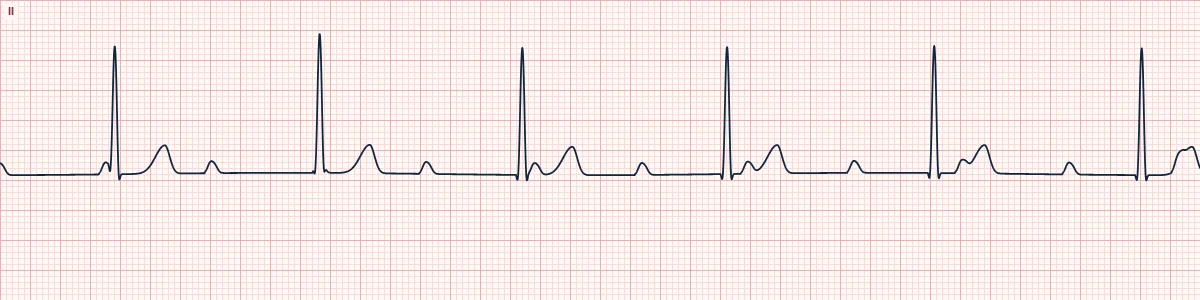
No atrial impulse reaches the ventricles. The atria follow the sinus node while a junctional escape pacemaker drives the ventricles independently with a narrow QRS.
What the heart is doing
Conduction is interrupted at the AV node. The sinus node paces the atria while a focus just below the block paces the ventricles through the normal His–Purkinje system, hence the narrow QRS.
Why it looks this way
This is third-degree AV block with junctional escape because P waves and narrow QRS complexes are each regular but completely unrelated, with more P waves than QRS.
Why it matters
A junctional escape is fairly dependable and may respond to atropine, but perfusion can still be poor. Symptomatic patients need pacing; block from inferior infarction or drugs is often reversible.
What to look for
- March out the P waves and the QRS complexes separately: each is regular, at different rates.
- The PR is different on every beat, and some P waves are buried in QRS complexes or T waves.
- A regular ventricular rhythm with a varying PR means AV dissociation.
Frequently asked questions
What are the ECG criteria for third-degree AV block, junctional escape?
Rate: atrial 60–100/min; ventricular 40–60/min. Rhythm: P–P regular and R–R regular, but unrelated. P waves: normal; march through QRS and T waves. PR interval: varies randomly (no true PR). QRS: narrow (< 120 ms).
How is third-degree AV block, junctional escape identified on an ECG?
This is third-degree AV block with junctional escape because P waves and narrow QRS complexes are each regular but completely unrelated, with more P waves than QRS.
What can third-degree AV block, junctional escape be mistaken for?
High-grade AV block: some beats have a repeating, fixed PR. 2:1 AV block: the PR is constant on the conducted beats. Accelerated junctional rhythm with dissociation: the junctional rate is faster than the atrial rate.
What causes third-degree AV block, junctional escape?
Common causes: inferior myocardial infarction; AV nodal blocking drugs, digoxin toxicity; lyme disease, myocarditis; congenital complete heart block; hyperkalemia; and degenerative conduction disease.