
Ischemia & prior infarction
Wellens pattern, type B (deep T inversion)
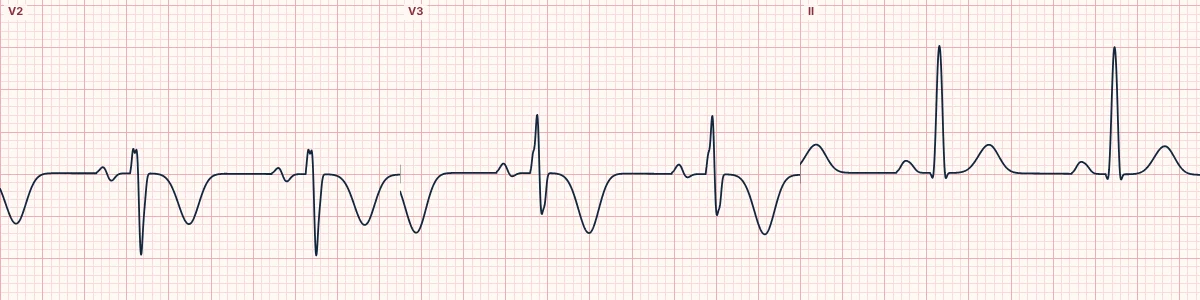
The more common form of the Wellens warning sign: deep, symmetric T-wave inversion in V2–V3 in a patient whose chest pain has settled, signalling a critical proximal LAD narrowing.
What the heart is doing
After temporary LAD occlusion and reperfusion, the anterior wall repolarizes late and in reverse order. The T-wave vector points away from the front of the chest, inverting the T in V2–V4.
Why it looks this way
This is Wellens pattern type B because V2–V3 show deep symmetric T-wave inversion with preserved R waves and no significant ST elevation.
Why it matters
Signals a high risk of a large anterior infarction within days to weeks. Treat as an acute coronary syndrome needing urgent angiography; stress testing is dangerous and should be avoided.
What to look for
- Sharp, symmetric, arrowhead T inversions that are deepest in V2–V4.
- R waves are preserved, so this is not an old anterior infarct.
- Any return of pain with T waves flipping upright suggests the artery has closed again.
Frequently asked questions
What are the ECG criteria for wellens pattern, type B (deep T inversion)?
T waves: deep, symmetric inversion in V2–V3, often V1–V6. ST segment: isoelectric or < 1 mm elevated. QRS: no Q waves; R-wave progression preserved. Context: recent chest pain, now resolved.
How is wellens pattern, type B (deep T inversion) identified on an ECG?
This is Wellens pattern type B because V2–V3 show deep symmetric T-wave inversion with preserved R waves and no significant ST elevation.
What can wellens pattern, type B (deep T inversion) be mistaken for?
Apical hypertrophic cardiomyopathy: very high voltage and stable giant T inversions. Raised intracranial pressure: broad inversions with a very long QT. Pulmonary embolism: T inversion in V1–V4 and III with tachycardia.
What causes wellens pattern, type B (deep T inversion)?
Common causes: critical proximal LAD stenosis; spontaneous reperfusion of an LAD occlusion; coronary artery spasm; and unstable plaque with intermittent occlusion.