
Coronary occlusion (STEMI)
Distal RCA occlusion
Inferior STEMI
Blockage of the right coronary artery (RCA) beyond its right ventricular branches. It infarcts the inferior wall of the left ventricle.
What the heart is doing
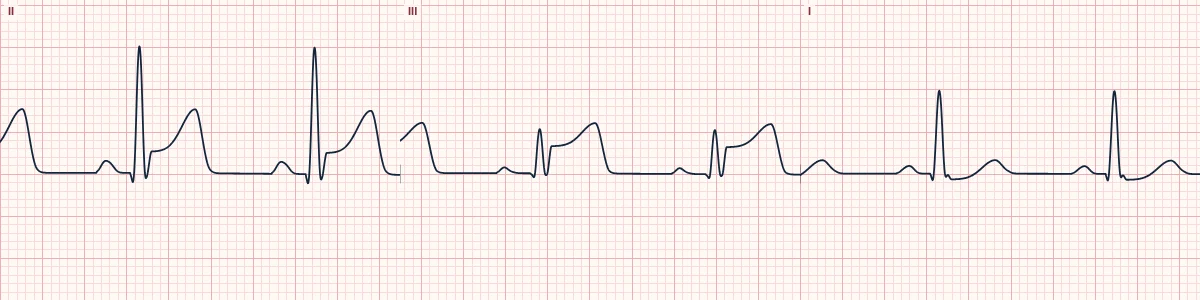
Transmural injury of the inferior wall creates an ST vector pointing downward and slightly rightward, toward lead III. The high lateral leads view it from the opposite side.
Why it looks this way
This is a distal RCA occlusion because ST elevation is limited to II, III and aVF, greatest in III, with reciprocal depression in I and aVL.
Why it matters
Usually a smaller infarct than an anterior STEMI, but bradycardia and AV nodal block are common because the RCA supplies the AV node. Reperfusion is urgent; check for right ventricular involvement.
What to look for
- ST elevation in the three inferior leads, largest in III.
- ST depression in aVL is the reciprocal sign and is often the earliest change.
- Record right-sided (V4R) and posterior (V7–V9) leads to define the extent.
Frequently asked questions
What are the ECG criteria for distal RCA occlusion?
Artery: distal RCA. ST elevation: II, III, aVF. Reciprocal ST depression: I, aVL. Pattern: ST elevation greater in III than in II. QRS: Q waves develop in III and aVF.
How is distal RCA occlusion identified on an ECG?
This is a distal RCA occlusion because ST elevation is limited to II, III and aVF, greatest in III, with reciprocal depression in I and aVL.
What can distal RCA occlusion be mistaken for?
Pericarditis: diffuse elevation, PR depression, no depression in aVL. Early repolarization: inferior J-point elevation with no reciprocal change. Left ventricular aneurysm: fixed elevation with deep inferior Q waves.
What causes distal RCA occlusion?
Common causes: plaque rupture with thrombosis; coronary artery spasm or stimulant use; spontaneous coronary dissection; and coronary embolism.