
Coronary occlusion (STEMI)
Proximal RCA occlusion
Inferior STEMI with right ventricular involvement
Blockage of the right coronary artery (RCA) before its right ventricular branches. It infarcts the inferior wall of the left ventricle and the right ventricle.
What the heart is doing
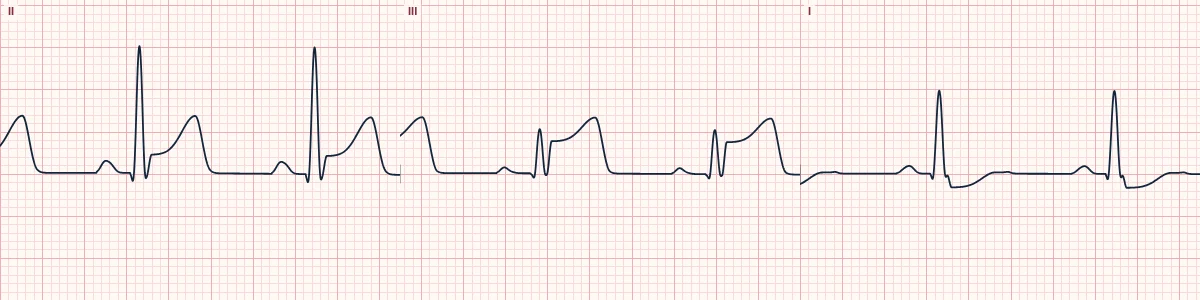
Injury to the inferior wall and right ventricle produces an ST vector pointing down and to the right. It aims at lead III and the right-sided chest leads and away from I and aVL.
Why it looks this way
This is a proximal RCA occlusion because inferior ST elevation, greatest in III, comes with elevation in V1 and V4R and reciprocal depression in I and aVL.
Why it matters
The infarcted right ventricle depends on preload: nitrates and other vasodilators can cause profound hypotension, and fluids may be needed. Expect bradycardia and AV block. Immediate reperfusion is the priority.
What to look for
- In any inferior STEMI, compare III with II: more elevation in III points to the RCA.
- ST elevation in V1 hints at right ventricular infarction; record V4R to confirm.
- ST elevation of 1 mm or more in V4R confirms right ventricular involvement.
Frequently asked questions
What are the ECG criteria for proximal RCA occlusion?
Artery: proximal RCA. ST elevation: II, III, aVF, V1, V4R. Reciprocal ST depression: I, aVL. Pattern: ST elevation greater in III than in II. Rhythm: sinus bradycardia and AV nodal block are common.
How is proximal RCA occlusion identified on an ECG?
This is a proximal RCA occlusion because inferior ST elevation, greatest in III, comes with elevation in V1 and V4R and reciprocal depression in I and aVL.
What can proximal RCA occlusion be mistaken for?
Circumflex occlusion: elevation in II at least equal to III, with V5–V6 involved. Pericarditis: elevation greater in II than III, with no depression in aVL. Anteroseptal STEMI: V1 elevation continues into V2–V4.
What causes proximal RCA occlusion?
Common causes: plaque rupture with thrombosis; coronary artery spasm or stimulant use; spontaneous coronary dissection; coronary embolism; and aortic dissection involving the RCA origin.