
The waves
Naming the QRS complex
Q, R, S and R′
Each part of the QRS has a letter. Naming them precisely makes descriptions such as rSR′ in V1 or QS in V2 mean the same thing to everyone.
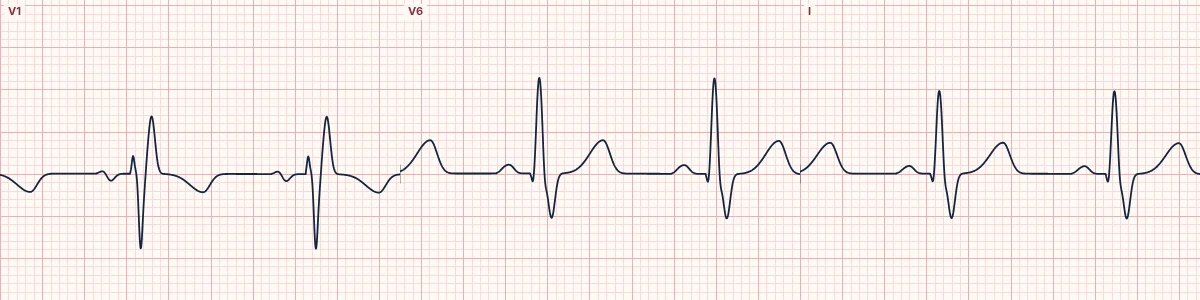
The letters
A Q wave is any downward deflection before the first upward one. An R wave is any upward deflection. An S wave is a downward deflection after an R. A second upward deflection is R′ (R prime). A complex that is entirely negative is a QS.
Capitals and small letters
Large waves get capital letters and small ones lower-case letters, so rS is a small r and a deep S (normal in V1) and qR is a small q and tall R (normal in V6).
What normal looks like
Small, narrow septal q waves are normal in I, aVL, V5 and V6: they record the septum activating from left to right. The QRS is normally under 120 ms wide.
How to read it
- Name each complex by its parts in order.
- Use rSR′ in V1 as the pattern to recognise right bundle branch block.
- A wide, notched R in V6 with a QS or rS in V1 suggests left bundle branch block.
Pitfalls
- Small septal q waves are normal; pathological Q waves are wide or deep.
Frequently asked questions
Naming the QRS complex: what is the key idea?
Each part of the QRS has a letter. Naming them precisely makes descriptions such as rSR′ in V1 or QS in V2 mean the same thing to everyone.
Naming the QRS complex: what are the key numbers?
Q: First negative, before any R; R: Any positive; S: Negative after an R; R′: Second positive; QS: Entirely negative.
Naming the QRS complex: how do you apply it to an ECG?
Name each complex by its parts in order. Use rSR′ in V1 as the pattern to recognise right bundle branch block. A wide, notched R in V6 with a QS or rS in V1 suggests left bundle branch block.
Naming the QRS complex: what are the common pitfalls?
Small septal q waves are normal; pathological Q waves are wide or deep.