
Paper and measurement
Correcting the QT for rate (QTc)
Bazett, Fridericia and the 500 ms line
The QT shortens as the heart speeds up, so the measured QT is corrected to what it would be at 60/min before deciding whether repolarization is prolonged.
The formulas
Bazett divides the QT by the square root of the R–R interval in seconds; it is the most widely printed but over-corrects at fast rates and under-corrects at slow ones. Fridericia divides by the cube root of the R–R interval and is more accurate away from 60/min. Both use the R–R interval preceding the measured QT.
Why it matters
A long QTc reflects delayed ventricular repolarization, which allows early afterdepolarizations and torsades de pointes. Risk rises steadily with QTc, and above 500 ms it is high enough that QT-prolonging drugs should be stopped and potassium and magnesium checked.
Causes of a long QT
Drugs (antiarrhythmics, some antibiotics, antipsychotics, antiemetics and many others), low potassium, magnesium or calcium, hypothermia, raised intracranial pressure, myocardial ischemia and inherited long QT syndromes.
How to read it
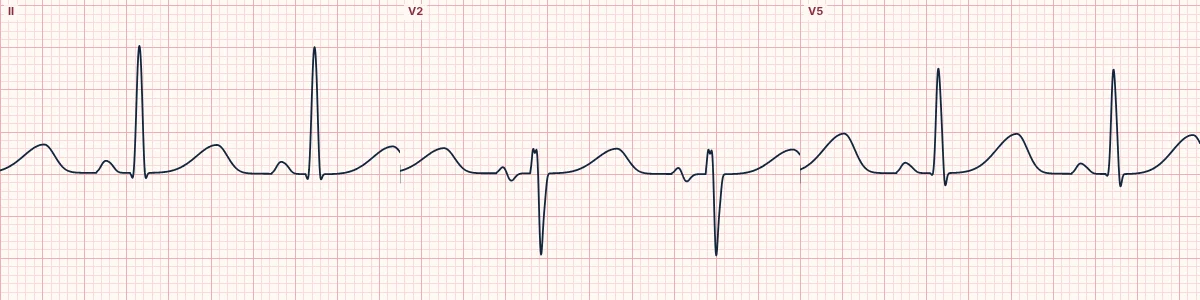
- Measure the QT in II or V5 from QRS onset to where the T wave meets the baseline.
- Measure the R–R interval before that beat.
- Correct with Fridericia when the rate is far from 60/min.
Pitfalls
- In atrial fibrillation, average the QT over several beats.
- A quick visual check: a QT longer than half the R–R interval at normal rates is probably long.
Frequently asked questions
Correcting the QT for rate (QTc): what is the key idea?
The QT shortens as the heart speeds up, so the measured QT is corrected to what it would be at 60/min before deciding whether repolarization is prolonged.
Correcting the QT for rate (QTc): what are the key numbers?
Bazett: QTc = QT / √RR; Fridericia: QTc = QT / ∛RR; Prolonged: > 450 ms men, > 460–470 ms women; High risk: > 500 ms; Short: < 340–360 ms.
Correcting the QT for rate (QTc): how do you apply it to an ECG?
Measure the QT in II or V5 from QRS onset to where the T wave meets the baseline. Measure the R–R interval before that beat. Correct with Fridericia when the rate is far from 60/min.
Correcting the QT for rate (QTc): what are the common pitfalls?
In atrial fibrillation, average the QT over several beats. A quick visual check: a QT longer than half the R–R interval at normal rates is probably long.