
Ventricular
Torsades de pointes
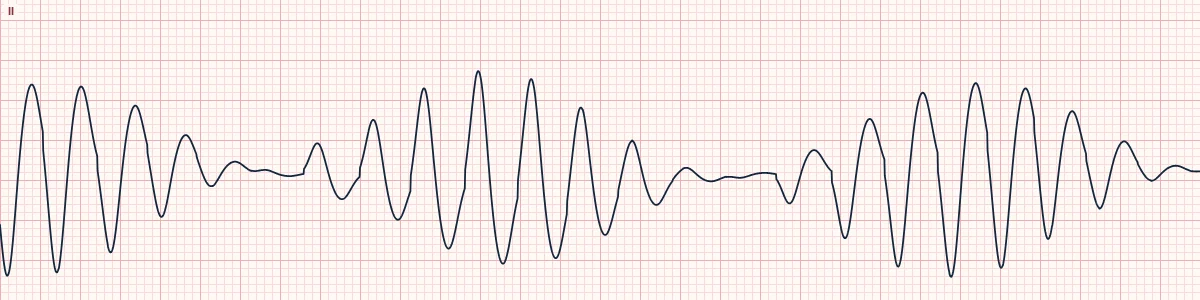
A form of polymorphic VT linked to a long QT interval. The complexes swell and shrink as if twisting around the baseline.
What the heart is doing
Prolonged repolarization allows early afterdepolarizations that trigger a beat during the T wave. Uneven recovery across the ventricle then sustains a drifting re-entrant wave, which rotates the QRS axis.
Why it looks this way
This is torsades de pointes because the wide complexes twist around the baseline in spindles, the hallmark of polymorphic VT with a long QT.
Why it matters
Often comes in self-terminating bursts but can become VF. Pulseless or sustained episodes need defibrillation. Otherwise give magnesium, stop QT-prolonging drugs, correct electrolytes and prevent slow rates.
What to look for
- A spindle or ribbon shape: complexes grow, shrink to almost nothing, then grow in the opposite direction.
- It often starts after a pause, with a PVC landing on a long, late T wave.
- Measure the QT on sinus beats between runs.
Frequently asked questions
What are the ECG criteria for torsades de pointes?
Rate: usually 200–250/min. Rhythm: irregular. QRS: wide; amplitude waxes and wanes in spindles. Axis: rotates around the baseline every 5–20 beats. Baseline QT: prolonged (QTc usually > 500 ms).
How is torsades de pointes identified on an ECG?
This is torsades de pointes because the wide complexes twist around the baseline in spindles, the hallmark of polymorphic VT with a long QT.
What can torsades de pointes be mistaken for?
Polymorphic VT with normal QT: chaotic changes without a smooth twist; think ischemia. Coarse ventricular fibrillation: no organized complexes or spindles. Artifact from movement: underlying QRS complexes march through.
What causes torsades de pointes?
Common causes: QT-prolonging drugs (antiarrhythmics, antipsychotics, some antibiotics); hypokalemia; hypomagnesemia; hypocalcemia; congenital long QT syndrome; and marked bradycardia or AV block.