
Leads and axis
The limb leads and the hexaxial system
Six views of the frontal plane
Four limb electrodes produce six leads that look at the heart from different angles in the frontal plane. Arranged around a circle, they form the hexaxial reference system used to find the axis.
Bipolar leads
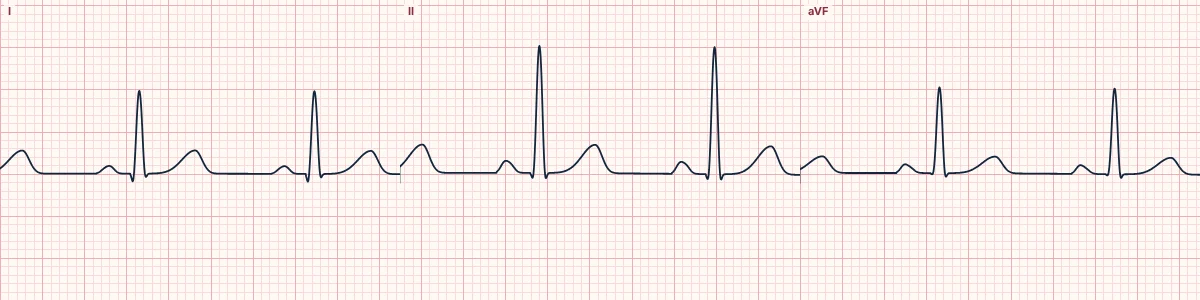
Lead I looks from the left arm with the right arm as reference (0°), lead II from the left leg against the right arm (+60°) and lead III from the left leg against the left arm (+120°). Einthoven's law holds at every instant: I + III = II.
Augmented leads
aVR (−150°), aVL (−30°) and aVF (+90°) each compare one limb with the average of the other two. Because they look at the heart from evenly spaced angles, aVR + aVL + aVF always sum to zero.
Reading positive and negative
A wave travelling toward a lead's positive pole writes an upward deflection, one travelling away writes a downward deflection, and one at right angles writes a small or biphasic one. This single rule explains every waveform shape.
aVR is the odd one out
It looks at the heart from the upper right, so in sinus rhythm almost everything in aVR points down: P wave, QRS and T wave. An upright P in aVR, or a dominant R in aVR, is always worth explaining.
How to read it
- Turn on the heart panel's axis view and watch the vector arrow sweep across the hexaxial wheel during each beat.
- Leads whose positive pole the vector points toward show the tallest R waves.
- Check aVR: in sinus rhythm it is negative throughout.
Pitfalls
- Swapped arm electrodes invert lead I and swap II with III and aVR with aVL, mimicking dextrocardia.
- The limb leads say nothing about front and back; that needs the chest leads.
Frequently asked questions
The limb leads and the hexaxial system: what is the key idea?
Four limb electrodes produce six leads that look at the heart from different angles in the frontal plane. Arranged around a circle, they form the hexaxial reference system used to find the axis.
The limb leads and the hexaxial system: what are the key numbers?
I: 0°; II: +60°; III: +120°; aVF: +90°; aVL: −30°; aVR: −150°.
The limb leads and the hexaxial system: how do you apply it to an ECG?
Turn on the heart panel's axis view and watch the vector arrow sweep across the hexaxial wheel during each beat. Leads whose positive pole the vector points toward show the tallest R waves. Check aVR: in sinus rhythm it is negative throughout.
The limb leads and the hexaxial system: what are the common pitfalls?
Swapped arm electrodes invert lead I and swap II with III and aVR with aVL, mimicking dextrocardia. The limb leads say nothing about front and back; that needs the chest leads.