
Leads and axis
Right-sided and posterior leads
V4R and V7–V9
The standard 12 leads miss the right ventricle and the back of the left ventricle. Moving chest electrodes to the right (V4R) or around the back (V7–V9) fills those gaps when an inferior or posterior infarction is suspected.
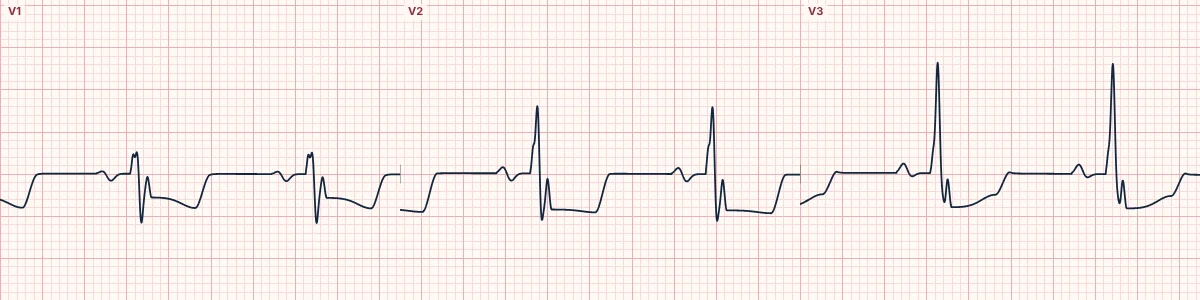
Right-sided leads
Place the chest electrodes in the mirror-image positions on the right chest. V4R, in the fifth intercostal space in the right midclavicular line, is the most useful. ST elevation there in an inferior infarction points to proximal right coronary occlusion with right ventricular involvement, which matters because those patients depend on preload.
Posterior leads
V7 sits in the left posterior axillary line, V8 at the tip of the scapula and V9 beside the spine, all level with V6. Posterior infarction shows as ST depression in V1–V3 on the standard ECG, the mirror image of ST elevation that V7–V9 record directly.
How to read it
- Record V4R in every inferior ST elevation.
- Record V7–V9 when V1–V3 show horizontal ST depression with upright T waves.
- Label the printout so the leads are not read as standard ones.
Pitfalls
- Right ventricular ST elevation is transient and can resolve within hours.
- Posterior ST elevation is small because the electrodes are far from the heart; use the lower threshold.
Frequently asked questions
Right-sided and posterior leads: what is the key idea?
The standard 12 leads miss the right ventricle and the back of the left ventricle. Moving chest electrodes to the right (V4R) or around the back (V7–V9) fills those gaps when an inferior or posterior infarction is suspected.
Right-sided and posterior leads: what are the key numbers?
V4R: 5th ICS, right midclavicular line; V7: Left posterior axillary line; V8: Tip of the left scapula; V9: Left paraspinal; Posterior STE: ≥ 0.5 mm in V7–V9; Right ventricular STE: ≥ 0.5 mm in V4R.
Right-sided and posterior leads: how do you apply it to an ECG?
Record V4R in every inferior ST elevation. Record V7–V9 when V1–V3 show horizontal ST depression with upright T waves. Label the printout so the leads are not read as standard ones.
Right-sided and posterior leads: what are the common pitfalls?
Right ventricular ST elevation is transient and can resolve within hours. Posterior ST elevation is small because the electrodes are far from the heart; use the lower threshold.