
Approach to tachycardia
Narrow-complex tachycardia
Regular or irregular, and where are the P waves?
A narrow QRS means the ventricles are being activated through the normal conduction system, so the rhythm starts above the ventricles. Regularity and the position of the P waves narrow the diagnosis.
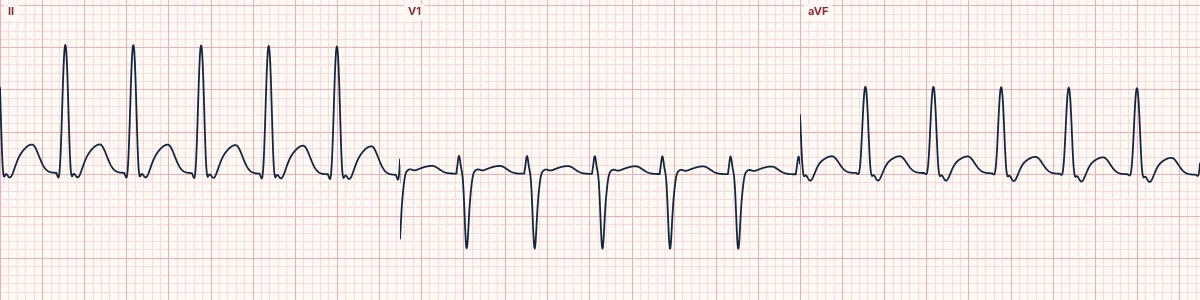
Irregular
Irregularly irregular with no organised atrial activity is atrial fibrillation. Irregular with at least three different P-wave shapes is multifocal atrial tachycardia. Atrial flutter with varying block is irregular but shows regular flutter waves.
Regular with visible P waves
Sinus tachycardia has normal P waves before each QRS and usually starts and stops gradually. Atrial tachycardia has abnormal P waves, often with a long RP. A rate close to 150 should always raise atrial flutter with 2:1 block.
Regular without visible P waves
AV nodal re-entry (AVNRT) hides the P wave inside or just after the QRS, sometimes as a pseudo-r′ in V1 or pseudo-S in the inferior leads. Orthodromic AV re-entry (AVRT) puts a retrograde P wave in the ST segment, more than 70 ms after the QRS.
Vagal manoeuvres and adenosine
Re-entry through the AV node (AVNRT and AVRT) usually terminates. Atrial flutter and atrial tachycardia slow transiently, which unmasks the atrial activity.
How to read it
- Decide regular or irregular.
- Search every lead for P waves and note their position relative to the QRS.
- Record the rhythm during any vagal manoeuvre or adenosine.
Pitfalls
- Sinus tachycardia is usually a response to illness; treat the cause, not the rate.
Frequently asked questions
Narrow-complex tachycardia: what is the key idea?
A narrow QRS means the ventricles are being activated through the normal conduction system, so the rhythm starts above the ventricles. Regularity and the position of the P waves narrow the diagnosis.
Narrow-complex tachycardia: what are the key numbers?
Irregular: AF, MAT, flutter with variable block; Regular, P before QRS: Sinus or atrial tachycardia; Regular, rate ~150: Consider 2:1 flutter; No visible P: AVNRT likely; Retrograde P in ST: AVRT likely.
Narrow-complex tachycardia: how do you apply it to an ECG?
Decide regular or irregular. Search every lead for P waves and note their position relative to the QRS. Record the rhythm during any vagal manoeuvre or adenosine.
Narrow-complex tachycardia: what are the common pitfalls?
Sinus tachycardia is usually a response to illness; treat the cause, not the rate.